


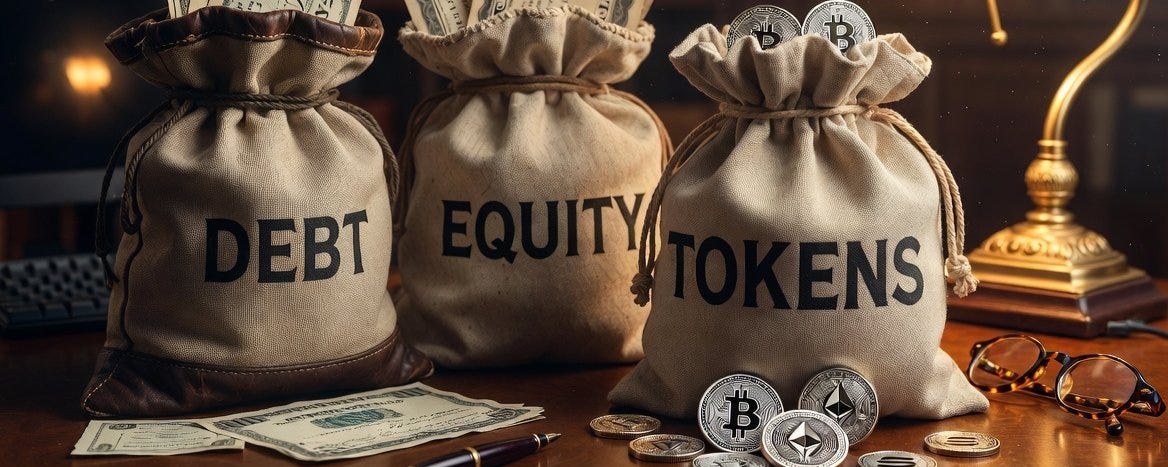
So let’s end the token-vs-equity debate. It’s a category error running on a ten-year-old framework.
I’ve been hearing it since 2017 at 49 Bogart, in the earliest days of ETH. SAFTs were all the rage. Literally rage-bait.
Nobody asks Alphabet to choose
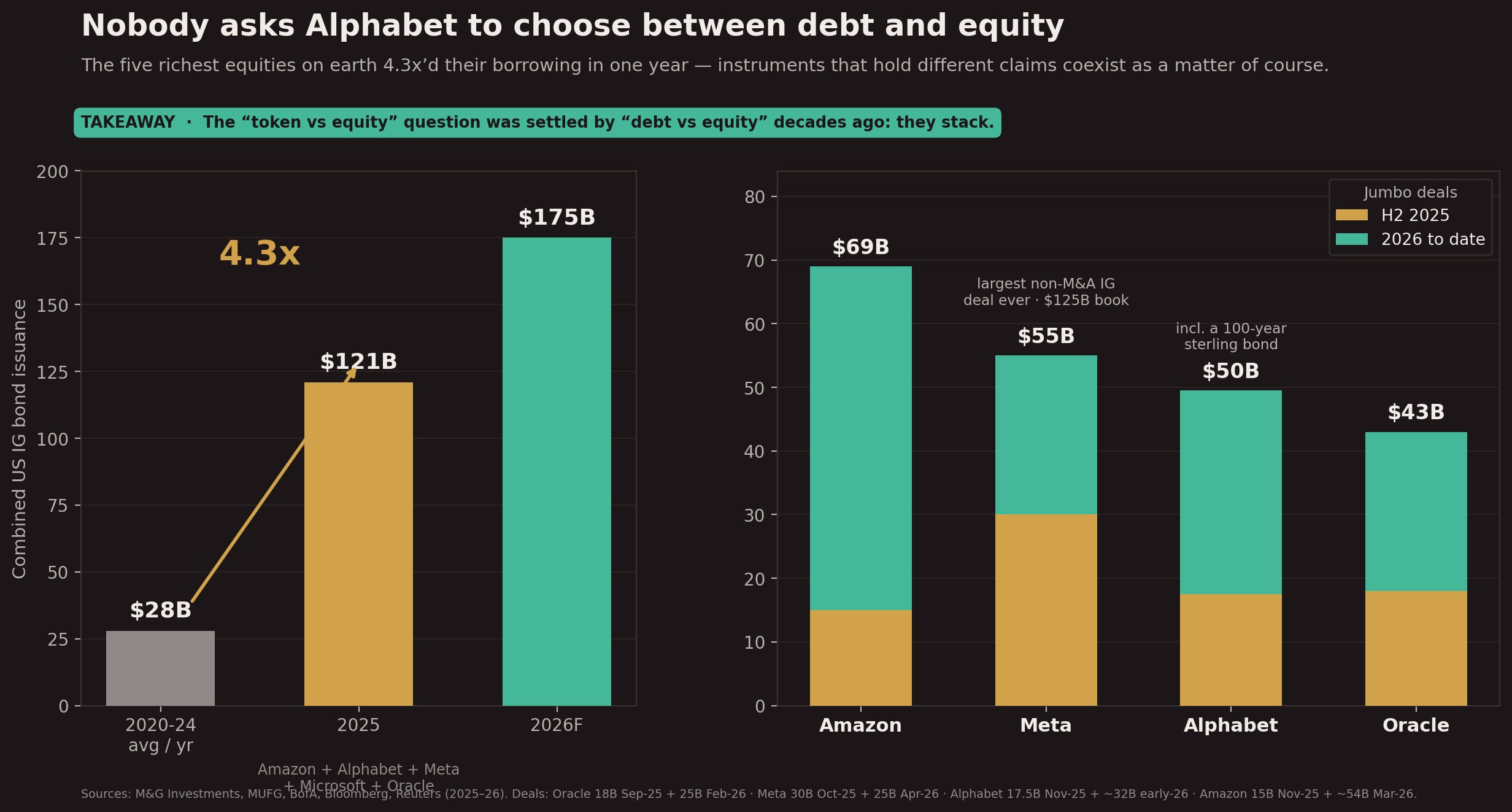
Meta sold $30 billion of bonds in one deal — the largest non-M&A investment-grade sale ever, with a $125 billion order book. Then came back for $25 billion more.
Alphabet priced roughly $32 billion this year, including a 100-year sterling bond.
Amazon did about $54 billion in March. Oracle is running a $45–50 billion plan across debt, equity-linked paper, and common stock. All three at once.
You get the point. Five hyperscalers that averaged $28 billion a year of issuance for half a decade did $121 billion in 2025. $175 billion forecast for this year.
Trillion-dollar equities issuing jumbo debt. Nobody asks them to choose, because the question would be meaningless. The instruments hold different claims and do different jobs.
Crypto is the only capital market on earth still arguing about whether two instruments can coexist.
The right question to ask: which claim does each instrument hold, and what is that claim worth...?
The history nobody teaches: your grandfather’s stocks were a scam asset
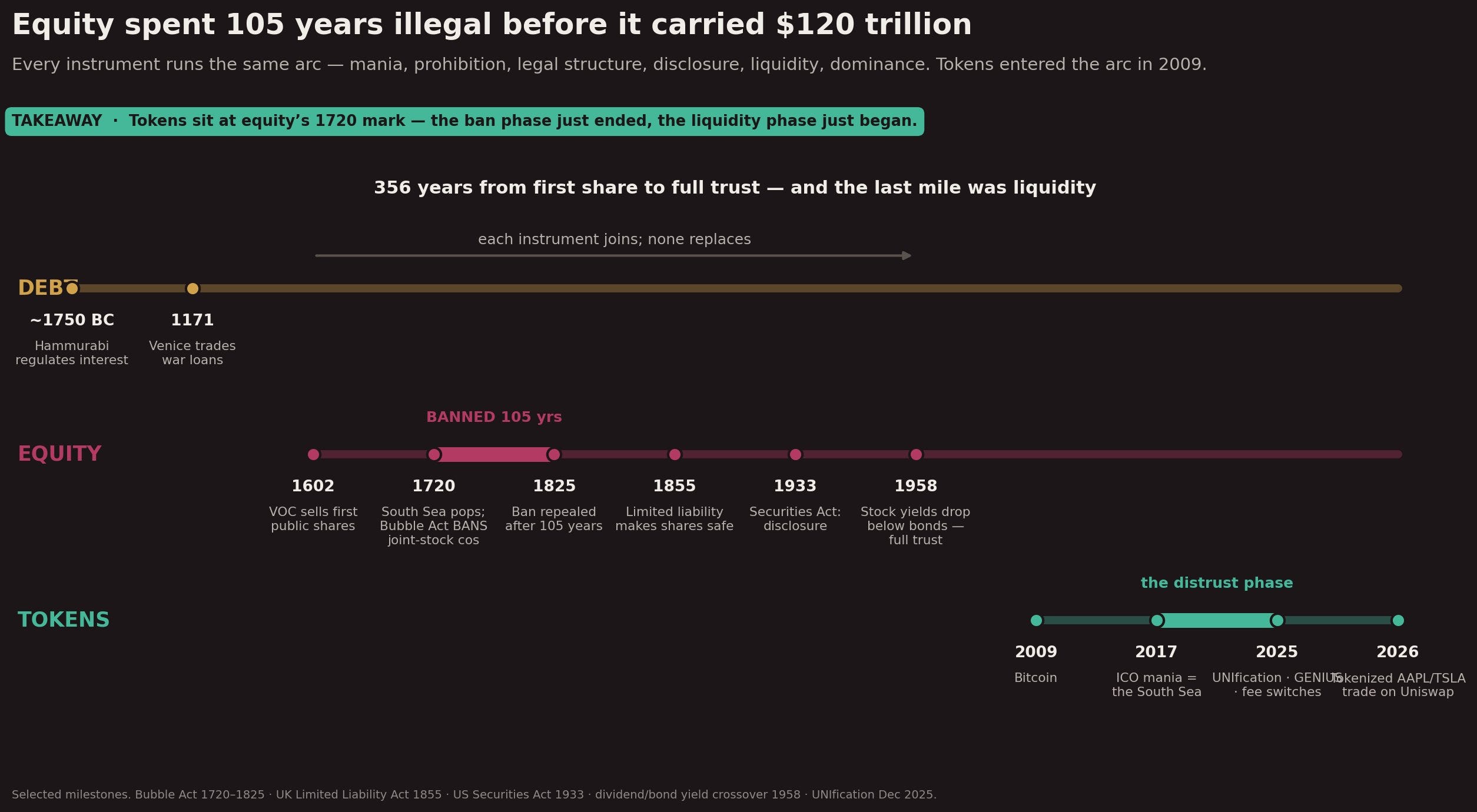
Debt ran finance alone for three thousand years. Hammurabi regulated interest rates around 1750 BC. Venice was trading war loans by 1171. Through all of it, the idea that strangers could collectively own an enterprise barely existed.
Equity showed up in 1602 - - the Dutch East India Company, the first public shares. And the world did what it always does with a new instrument: fascination, mania, prohibition.
The South Sea Bubble popped in 1720. England’s answer was the Bubble Act: joint-stock companies were banned for a century. Kinda like tokens were shadow-banned.
Hold that thought for a sec ... Equity, the instrument that now carries about $120 trillion of the world’s wealth spent a hundred years illegal in the most sophisticated financial market on earth. Because it was considered a scam vehicle.
The rehabilitation took three inputs, in order.
Legal structure. Limited liability, 1855. Owning a share became survivable.
Disclosure. The Securities Act, 1933. Claims became verifiable.
Liquidity. The ability to get out is what made people willing to get in.
The cleanest marker of equity’s maturation is a date almost nobody knows. Until 1958, stocks yielded more than bonds — the market charged a distrust premium for holding them. In 1958 the yields crossed. They never crossed back.
356 years from the first share to full trust. The last mile was pure liquidity.
And the pattern that pays: the new instrument never killed the old one. Bonds grew larger after equity matured because a liquid equity layer beneath made lending safer. The instruments compound each other.
They stack up nicely...
Tokens are equity in 1720. That’s where we are.
Run the same clock on the third instrument.
Bitcoin, 2009. The ICO mania of 2017 was our South Sea — real innovation wrapped in fraud, followed by regulatory hostility that worked like a partial Bubble Act.
Now watch the maturation inputs arrive in the exact same order. Legal structure: GENIUS signed; CLARITY on the floor; Singapore and ADGM maintaining the registries. Disclosure: on-chain transparency plus the proof layer. Liquidity: the ETFs, tokenized treasuries — and the detail that should stop you cold: as of June, tokenized Apple, Tesla, and SpaceX trade on Uniswap itself.
The venues have already merged. The industry kept debating while the instruments converged on the same rails.
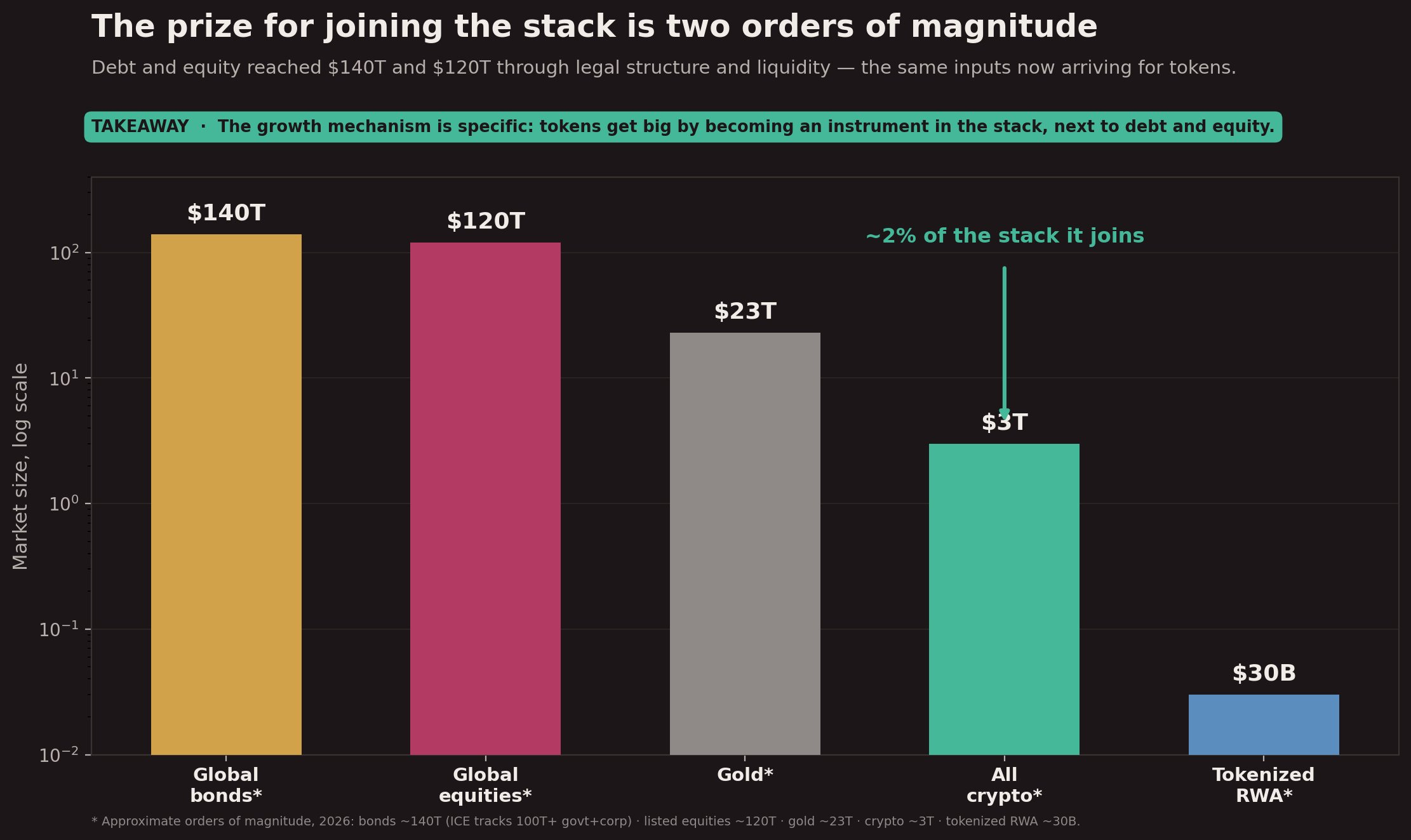
The room: global bonds around $140 trillion. Global equities around $120 trillion. All of crypto, about $3 trillion.
Tokens are onluy two percent of the stack they’re joining, standing at the 1720 mark of a curve history has run twice.
The three claims
One protocol can carry all three instruments. Each holds a claim that the others structurally cannot.
Senior debt claims the fee stream. A protocol with predictable revenue borrows against it, the way Alphabet borrows against search. Cheapest capital there is. Dilutes nobody. And it ends the practice crypto never questioned, financing payroll by selling the token. Every treasury dumping its own token is using its equity-est instrument to do debt’s job. That’s why token charts bleed.
Equity claims the operating company. The labs, the interfaces, the licenses, the team. That claim is real, and it belongs to shareholders. The error was promising the token would capture value while the cap table quietly did.
The token claims the machine layer. The protocol-enforced, slashable bond that machines must lock to act, plus the metered work routed through it. And here’s the property no share or bond has: a smart contract can automatically seize it for misbehavior.
Code can’t slash a share. Code can’t slash a bond indenture.
The token is the only instrument that can be machine-grade skin in the game. Its job was never to imitate equity.
Its job is to be drum beat...bond.
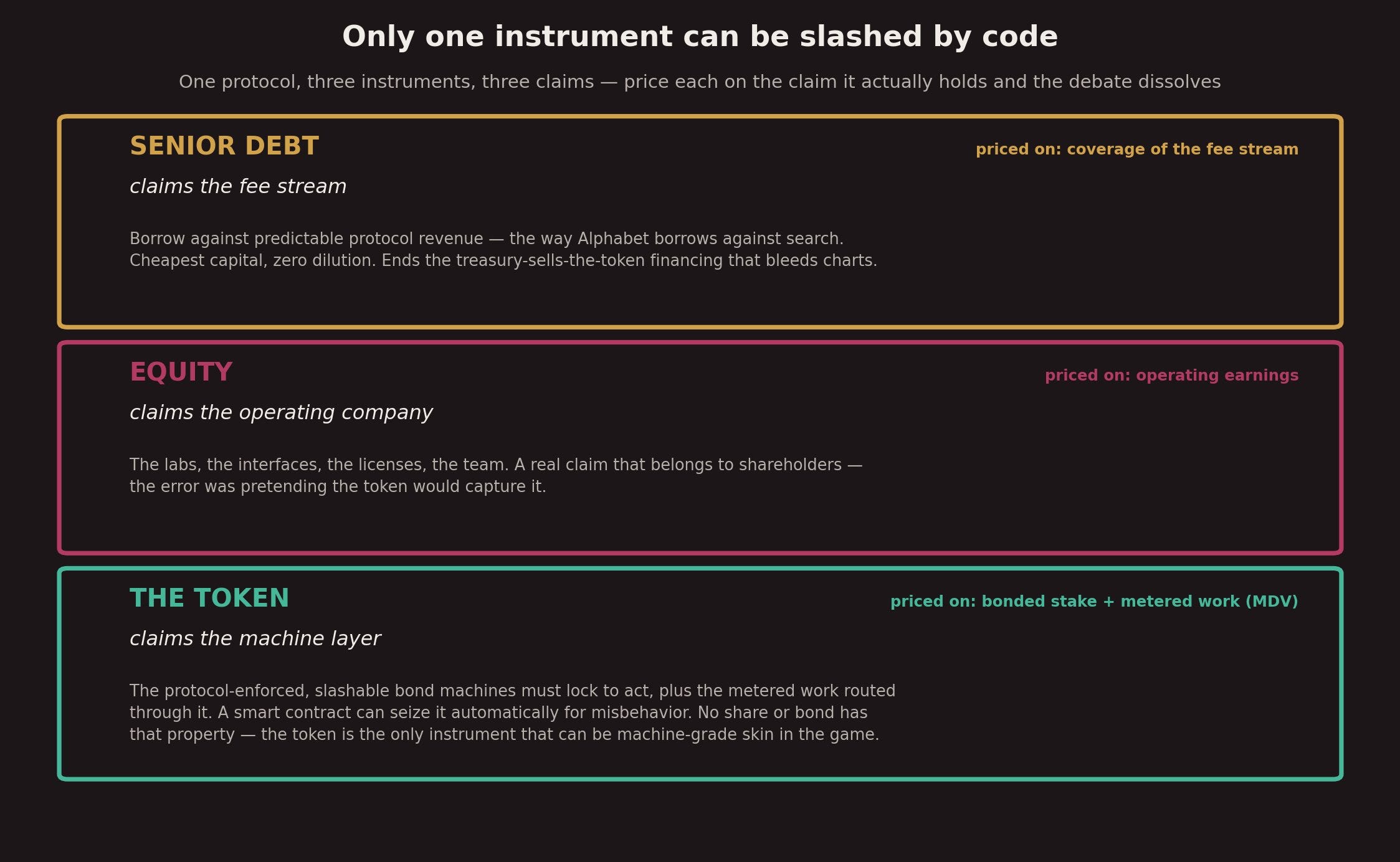
Price each instrument on its own claim, and the debate dissolves. Debt on coverage. Equity on earnings. The token on bonded work and metered demand.
We’re now moving towards three multiples, three disciplines, and one protocol/product.
How the token grows when the stack shows up
I will write something much more detail and clear and a framework you can feed your IA but basically there are four gears. No hopium.
Debt takes the financing load off the token. The treasury stops using the token as the company ATM, and the structural sell pressure that has crushed every treasury-funded token in history goes with it.
Equity takes the operating-company claim. The token’s claim gets cleaner. Ambiguity about what a token is owed trades at a discount, the full stack deletes the ambiguity.
The liquidity flywheel runs again. Legal structure, disclosure, and exitability took equity from banned to $120 trillion. Every input is now arriving for tokens on schedule.
And the bonded claim scales with the machine economy itself. As accountable machine work grows, the slashable bond guaranteeing it grows in lockstep. That’s a claim whose underlying quantity compounds for twenty-five years.
Crypto grows up the day a protocol CFO can say, with a straight face: senior notes financed the datacenter, shareholders own the company, and the token is the bond the machines post.
The untapped market is every protocol that can’t say that ... yet.